The following article is a translation from the Chinese, originally posted at Deutsche Welle on August 6, 2012, and re-posted by Chang Ping to his personal weblog on September 3.
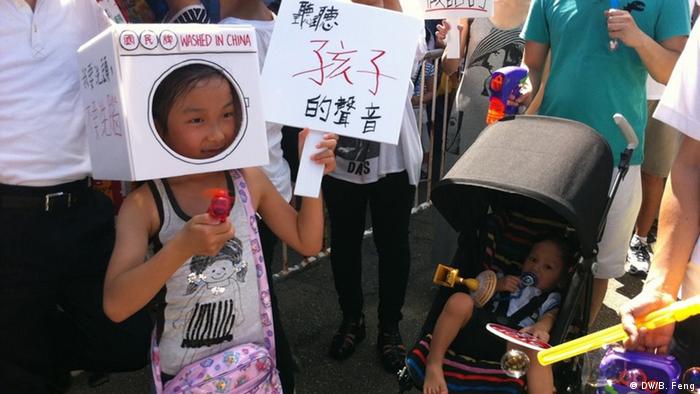
Opposition is still growing in Hong Kong to a proposed curriculum of national education, orguomin jiaoyu (国民教育), that many locals believe is being pushed by Beijing. A hunger strike action planned for today (August 6) was postponed. But supposing the government does not give up these plans, more protests can be expected with the beginning of the school term in September.
News media inside China have continued to push the case for national education in Hong Kong. There was the Chinese-language Global Times running an editorial on August 2 arguing that national education would encourage young people in Hong Kong to expand their horizons, suggesting in a lofty, pedagogical tone: “The ultimate end to the controversy over national education in Hong Kong can only be ‘victory for China’. In pursuing only their own individual victories, these objectors are perhaps being unrealistic.” And an article in today’s (August 6) overseas edition of the People’s Daily said that promoting national education would help young people in Hong Kong better understand their country, and “only when young people understand and identify with their country can they accurately understand its policies, know their place, and seize opportunities. It is not wrong to work now for the future of young people.”
Is the Global Times correct in suggesting that there is only one possible outcome to this struggle? And is it right to suggest that China will be “victorious” if it forces through a national education curriculum?
The idea behind national education is that, beginning in the current academic year, authorities in Hong Kong supplement the original moral education curriculum with national education content. Judging from teaching materials that have already become public, this curriculum follows the lines somewhat of the so-called patriotic education carried out inside China by the Communist Party for years, using the framework of nationalism to address history and culture. And the curriculum resorts to outright lies in drawing a halo over the head of the so-called “China Model.”
Many in support [of the curriculum], whether the official in the mainland liaison office who once suggested that “brainwashing is necessary,” or the articles in the Global Times and the People’s Daily, have said that national education is carried out in Western countries, only in a different way. This need to point West is unusual, because as soon as anyone brings up democracy and freedom these very same officials and state media say that [China] will “resolutely not follow Western [political] models.” But of course so-called “national education” in the West is inseparable from their political systems, speech environments and concepts of human rights.
This inconsistency of logic appears again and again in China’s public opinion environment, and there is a great big market for it. For example, if you advocate the idea of learning from Western countries, suggesting that more benefits should be given to people in lower social strata, they will fire right back with the argument that China’s population is too big, that if everyone is given more benefits this will work out to be a huge number and there is no way society can support it — therefore there’s no way things can be done as they are in the West.
If you change the subject to government corruption, no one will think to apply the same logic, that there are too many officials in China and if every official takes a bit on the side this will work out to a huge sum and there is no way society can bear it, therefore Chinese officials must be cleaner than those in the West. In fact, the Global Times will argue, as it did earlier this year, that the people of China should tolerate “moderate corruption” among officials.
Moreover, these officials and media speak in generalities about “national education in Western countries,” but they have never explained specifically what they are talking about. The People’s Daily said that it was “only different in form.” If we’re talking about the fact that these [forms of national education] are not a forced inculcation, or that they are not premised on lies, then I suppose the differences are quite substantial indeed.
The majority of developed countries in the West did have different forms of “national education”, and some might even have been construed as “partisan education” about loving one’s country, one’s party or one’s leaders. But since the end of the Second World War, ideas, culture and education in Western developed nations have basically made their way out of the morass of pre-modern concepts of nationalism through a process of self-examination and deconstruction.
One might argue that this reassessment is a kind of reconstitution and consolidation of national visions of cultures and political systems, but freedom of thought, open media, cultural diversity and democracy are preconditions, and [this reconstitution] is a process of constantly challenging illegitimate systems, overturning governments that displease, and transforming culture.
The editorial in the People’s Daily said that “without a clear identification with their country and a sense of cultural belonging, young people have no way of truly participating in discussion and decision-making in society, and a modern nation cannot develop in a healthy manner — this has long been something of which the public is aware.”
In fact, it’s this pre-modern notion of nationalism that has long been a subject of public questioning, even if we admit that a sense of national identity and cultural belonging are important, and if people are given the opportunity to seek out this sense of identity and belonging, then they will inevitably stand up, opposing media that monopolize ideas, education that strangles culture, and governments and corrupt officials that strip citizens of their rights. This, in fact, is precisely what young people in Hong Kong who take part in the June Fourth commemoration in Victoria Park, who voice their support for Liu Xiaobo’s “Charter Eight” and who oppose national education in Hong Kong are up to.
This is a necessary contradiction that authoritarian regimes face when they call on the people to love their country. When the Chinese Communist Party, then regarded as an opposition party, called on the people to resist the corrupt government of the Kuomintang [in the beginning of the last century], they labeled themselves as patriots.
This round of protests in Hong Kong is of utmost importance. Inside mainland China, the Chinese Communist Party has conducted its program of “national education” for more than 60 years, and the results are apparent to all. Those who have received this education find it difficult to expand their horizons — they are closed-minded and intolerant. In this era of exploding information, what many young Chinese glimpse through the smoke are still elemental notions like “patriotism”, “treachery,” “China’s rise” and “Western conspiracies.” The privileged, rich and powerful who have an opportunity to expand their horizons are steadily streaming overseas — and what does that say about their sense of identification and belonging?
If a curriculum of this type is rolled out in Hong Kong, this will be the territory’s fate as well. The vast majority of people will have the wool pulled over their eyes while the elite muddle along, and in the end China will have deprived itself of a valuable window that can ventilate the country with ideas.
Fortunately, this movement has already begun, and it won’t possibly end, as the Global Times suggests, with “victory for China.” This process of resistance is the real “national education.” And the young people who receive this education will only identify more deeply with freedom of thought and cultural diversity under a system of democratic politics.